Executive Summary
Pineapple leather is one of the most innovative plant-based alternatives to animal leather. Made primarily from pineapple leaf fibres - an agricultural by-product that would otherwise be left to decompose or be burned - it transforms agricultural waste into a durable, leather-like material for shoes, bags and accessories.
The best-known pineapple leather is Piñatex®, developed by Ananas Anam. Since its introduction, it has become one of the world's most recognised plant-based materials, demonstrating how agricultural by-products can be transformed into high-quality fashion.
Like every material, pineapple leather has both strengths and limitations. It reduces dependence on animal leather, creates value from existing agricultural waste and supports more resource-efficient production. At the same time, many commercially available versions still rely on protective coatings to improve durability and water resistance, meaning they are not always fully biodegradable.
At NEW WORLD GUARDIANS, we believe informed choices begin with understanding the materials behind the products we buy. This guide explores how pineapple leather is made, its sustainability, advantages, limitations and how it compares with animal leather and other innovative vegan materials.
Quick Answer
Pineapple leather is a plant-based material made primarily from fibres extracted from pineapple leaves, an agricultural by-product of pineapple farming.
The best-known example is Piñatex®, developed by Ananas Anam. Instead of using the fruit itself, pineapple leather utilises the long fibres naturally found inside pineapple leaves, giving agricultural waste a second life.
Compared with animal leather, pineapple leather avoids animal hides while making better use of existing natural resources. Although its sustainability depends on the manufacturing process and protective coatings used, it represents one of the most promising innovations in vegan fashion materials.
Pineapple Leather at a Glance
| Feature | Assessment |
|---|---|
| Material Type | Plant-based leather alternative |
| Raw Material | Pineapple leaf fibres |
| Best-known Material | Piñatex® |
| Animal-Free | ✅ Yes |
| Renewable Resource | ✅ Yes |
| Uses Agricultural By-products | ✅ Yes |
| Durability | Good |
| Water Resistance | Moderate (depends on finish) |
| Biodegradability | Partial (depends on coating) |
| Common Uses | Shoes, bags, wallets, belts and accessories |
Why Pineapple Leather Matters
The fashion industry is increasingly searching for materials that reduce reliance on animal-derived products while lowering environmental impact. Pineapple leather has emerged as one of the most recognised innovations because it transforms agricultural waste into a valuable fashion material.
Every year, millions of pineapple plants are harvested for their fruit, leaving behind large quantities of leaves that traditionally have little commercial value. Rather than allowing these leaves to decompose or be burned, manufacturers can extract their strong natural fibres and transform them into a durable textile suitable for fashion applications.
This approach supports a more circular economy by making better use of existing resources instead of producing additional raw materials.
For consumers looking for vegan alternatives, pineapple leather demonstrates how innovation can help create more responsible choices without relying on animal leather.
What Is Pineapple Leather?
Pineapple leather is a leather-like material produced primarily from pineapple leaf fibres.
Despite its name, the material is not made from the pineapple fruit. Instead, manufacturers use the long cellulose fibres naturally found inside the leaves of the pineapple plant (Ananas comosus). These leaves remain after harvesting the fruit, making them an agricultural by-product rather than an additional crop grown specifically for textile production.
After extraction, the fibres are washed, dried and processed into a non-woven textile. This textile forms the structural foundation of the finished material before protective finishing layers are applied to improve flexibility, durability and water resistance.
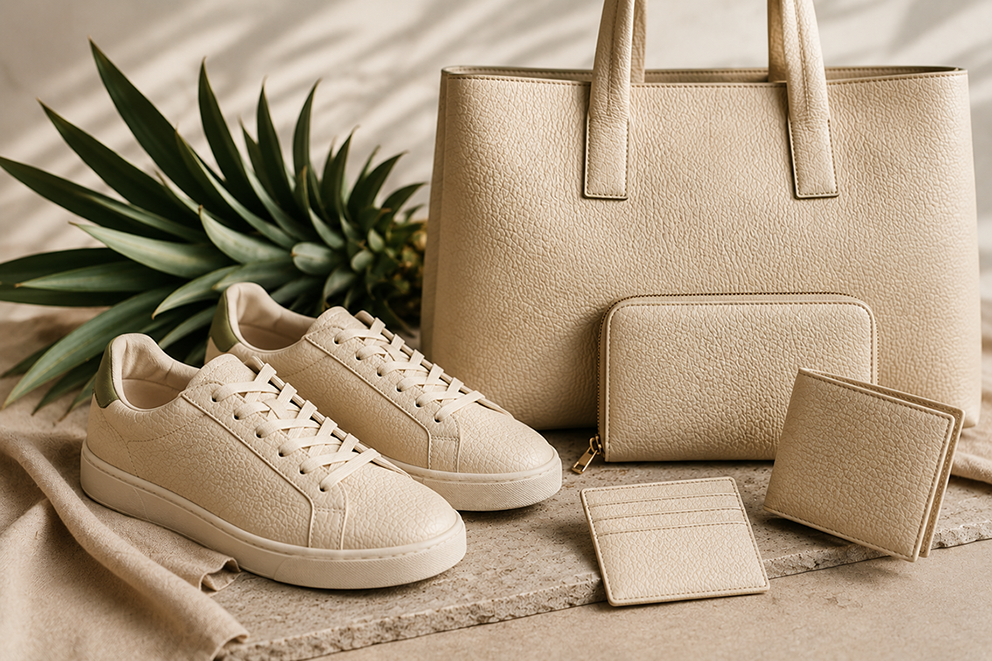
Today, pineapple leather is used in a wide variety of fashion products, including shoes, handbags, backpacks, wallets, belts and other accessories.
Its distinctive natural texture gives many products a unique appearance while offering designers an innovative vegan alternative to animal leather.
What Is Piñatex®?
When people talk about pineapple leather, they are often referring to Piñatex®.
Developed by Ananas Anam, Piñatex is the world's best-known commercial pineapple leather. The company pioneered a manufacturing process that transforms pineapple leaf fibres into a durable non-woven textile suitable for fashion and accessories.
Although Piñatex helped introduce pineapple leather to the global fashion industry, it is important to distinguish between the two terms. Pineapple leather is the broader material category, while Piñatex® is one specific branded product.
As innovation continues, additional manufacturers are exploring their own pineapple fibre materials, making pineapple leather an increasingly important category within sustainable fashion.
How Is Pineapple Leather Made?
One of the reasons pineapple leather has gained so much attention is its innovative use of agricultural by-products. Instead of relying on animal hides or growing crops specifically for textile production, it begins with pineapple leaves that remain after the fruit has been harvested.
The production process combines agricultural expertise with modern material engineering to transform these discarded fibres into a durable textile suitable for shoes, bags and accessories.
1. Harvesting the Pineapple Leaves
Pineapple plants are cultivated for their fruit, not for textile production. Once the fruit has been harvested, the leaves have traditionally been considered agricultural waste. In many growing regions, they are left to decompose naturally or are burned to prepare fields for the next harvest.
Pineapple leather gives these leaves a second life without requiring additional land, water or fertilisers.
Because the fibres come from existing agriculture, they do not compete with food production.
2. Fibre Extraction
The next step is extracting the strong natural fibres from the leaves.
This is typically done using a process called decortication, where specialised machines separate the long cellulose fibres from the softer plant tissue.
After extraction, the fibres are thoroughly washed before being dried naturally or in controlled drying facilities.
The remaining plant biomass can often be returned to the fields as organic fertiliser or used to generate bioenergy, helping to minimise waste.
3. Creating the Non-Woven Textile
Once cleaned and dried, the fibres are processed into a non-woven mesh.
Unlike traditional woven fabrics, the fibres are mechanically bonded together instead of being spun into yarn first. This creates a flexible yet strong textile that forms the structural base of the finished material.
At this stage, the material already offers many of the characteristics needed for fashion applications, including flexibility, strength and a distinctive natural texture.
4. Finishing the Material
To improve durability and performance, manufacturers apply protective finishing layers to the textile.
These finishes help enhance:
- flexibility
- abrasion resistance
- water resistance
- colour consistency
- surface appearance
The exact formulation varies between manufacturers and product collections. Some finishes create a smooth leather-like appearance, while others preserve more of the material's natural texture.
These finishing layers are also one of the main reasons why the environmental performance of pineapple leather can vary between products.
Is Pineapple Leather Sustainable?
Pineapple leather is widely recognised as one of the most promising plant-based alternatives to animal leather. While it offers several environmental advantages, no material is entirely impact-free.
Understanding both its strengths and its limitations helps consumers make more informed purchasing decisions.
At NEW WORLD GUARDIANS, we believe sustainability is about continuous improvement rather than perfect solutions.
Sustainability at a Glance
| Aspect | Assessment |
|---|---|
| Uses agricultural by-products | Excellent |
| Renewable raw material | Excellent |
| Animal-free | Excellent |
| Resource efficiency | Very Good |
| Durability | Good |
| Biodegradability | Needs Improvement (depends on coating) |
Why Pineapple Leather Can Be a More Sustainable Choice
It Gives Agricultural Waste a Second Life
One of pineapple leather's greatest strengths is its use of pineapple leaves that would otherwise have little commercial value.
Instead of becoming waste, these fibres are transformed into a durable textile, helping to maximise the value of existing agricultural resources without requiring additional farmland.
It Reduces Dependence on Animal Leather
Unlike conventional leather, pineapple leather does not rely on animal hides.
For consumers seeking vegan alternatives, it offers a material that avoids many of the ethical concerns associated with animal leather while helping diversify the range of plant-based fashion materials.
It Supports a More Circular Economy
Because pineapple leather makes use of an existing agricultural by-product, it reflects the principles of a more circular economy.
Rather than producing additional raw materials, it makes better use of resources that are already available.
It Can Benefit Farming Communities
Using pineapple leaves as a valuable raw material can create additional income opportunities for farming communities.
Although the economic benefits depend on the supply chain, this added value can contribute to more diversified and resilient agricultural systems.
The Limitations of Pineapple Leather
Like every innovative material, pineapple leather also has challenges that deserve consideration.
Protective Coatings Are Still Needed
Most commercially available pineapple leather materials require protective surface coatings to improve flexibility, durability and water resistance.
Depending on the manufacturer, these coatings may contain synthetic components. As a result, not every pineapple leather product is fully biodegradable or entirely plastic-free.
The industry continues to develop more bio-based alternatives that may further improve future generations of the material.
Manufacturing Remains Energy Intensive
Transforming pineapple leaves into a high-performance fashion material involves several processing stages, including fibre extraction, textile production and finishing.
Each step requires energy and resources, meaning the final environmental footprint depends on how efficiently the material is produced.
Availability Is Still Limited
Compared with animal leather, pineapple leather remains a relatively niche material.
Production volumes are much smaller, meaning it is currently available in fewer products and collections than more established materials.
NWG Perspective
At NEW WORLD GUARDIANS, we see pineapple leather as an exciting example of how innovation can help reduce reliance on virgin resources while creating value from agricultural by-products.
Although it is not yet a perfect material, its development highlights the positive direction in which sustainable fashion is moving. Continued advances in manufacturing and bio-based coatings are likely to make future generations even more resource-efficient and environmentally responsible.
Advantages of Pineapple Leather
Pineapple leather has become one of the most recognised plant-based alternatives to animal leather because it combines innovative material science with a more circular approach to resource use. While no material is perfect, pineapple leather offers several advantages for consumers looking for more sustainable fashion choices.
It Makes Use of Agricultural By-products
One of the greatest strengths of pineapple leather is that it gives new value to pineapple leaves that would otherwise have little commercial use.
Instead of becoming waste after the fruit is harvested, the fibres are transformed into a durable material suitable for shoes, bags and accessories. This helps maximise the value of existing agricultural resources without requiring additional farmland.
It Is Animal-Free
Unlike conventional leather, pineapple leather contains no animal hides.
For consumers looking for vegan fashion, it offers a cruelty-free alternative that supports more responsible material choices.
It Has a Distinctive Natural Look
Rather than trying to imitate animal leather perfectly, pineapple leather has its own unique appearance.
Its slightly textured surface reflects the natural structure of the fibres, giving products an authentic and contemporary aesthetic.
It Is Lightweight and Versatile
Pineapple leather is lightweight while offering sufficient strength for many everyday applications.
This makes it well suited for:
- Shoes
- Sneakers
- Handbags
- Wallets
- Belts
- Watch straps
- Fashion accessories
It Encourages Material Innovation
The success of Piñatex has inspired further research into agricultural by-products as raw materials for fashion.
Today, pineapple leather is part of a growing generation of innovative materials that includes apple leather, mushroom leather, cactus leather and other plant-based alternatives.
Limitations of Pineapple Leather
Like every material, pineapple leather also has limitations that should be considered before making a purchasing decision.
It Does Not Feel Exactly Like Animal Leather
Although pineapple leather has a leather-like appearance, it has its own texture and ageing characteristics.
Consumers expecting an identical replacement for premium full-grain leather may notice these differences.
Many people, however, appreciate pineapple leather precisely because it embraces its own natural character.
Durability Depends on the Product
The durability of pineapple leather varies depending on the manufacturing process, finishing and product construction.
High-quality products can provide years of everyday use when properly cared for, but they generally do not develop the same patina associated with premium animal leather.
Protective Coatings Influence Sustainability
To achieve the performance expected from modern fashion products, most pineapple leather materials include protective surface coatings.
These improve flexibility, abrasion resistance and water resistance, but they can also affect biodegradability and recyclability.
Pineapple Leather Compared
Pineapple Leather vs Animal Leather
| Feature | Pineapple Leather | Animal Leather |
|---|---|---|
| Source | Pineapple leaf fibres | Animal hides |
| Vegan | ✅ Yes | ❌ No |
| Uses agricultural by-products | ✅ Yes | ❌ No |
| Renewable raw material | ✅ Yes | Limited |
| Texture | Natural fibre texture | Natural grain |
| Durability | Good | Excellent |
| Water resistance | Moderate (depends on finish) | Good (with treatment) |
| Best suited for | Conscious everyday fashion | Traditional leather products |
Both materials have strengths, but they represent fundamentally different approaches to fashion.
Animal leather relies on livestock and tanning processes, while pineapple leather makes use of an agricultural by-product that already exists. For consumers seeking vegan and more resource-conscious alternatives, pineapple leather offers a compelling option without relying on animal hides. 👉 Read more about the truth behind animal leather
Pineapple Leather vs Apple Leather
| Feature | Pineapple Leather | Apple Leather |
|---|---|---|
| Raw material | Pineapple leaf fibres | Apple industry by-products |
| Agricultural waste | ✅ Yes | ✅ Yes |
| Vegan | ✅ Yes | ✅ Yes |
| Typical appearance | Slightly textured | Smooth and uniform |
| Common uses | Shoes, bags, accessories | Shoes, bags, accessories |
| Sustainability | Excellent use of crop residues | Excellent use of food industry by-products |
Both materials demonstrate how agricultural by-products can be transformed into innovative fashion materials.
Neither is universally "better". The right choice depends on the product, intended use and personal preference.
Is Pineapple Leather Right for You?
| If you value... | Assessment |
|---|---|
| Vegan materials | Excellent |
| Innovative design | Excellent |
| Circular use of resources | Excellent |
| Premium everyday fashion | Very Good |
| Long-term durability | Good |
| Traditional leather ageing | Needs Improvement |
Durability
One of the most common questions about pineapple leather is whether it lasts as long as animal leather.
The answer depends on how the material is manufactured, how the product is constructed and how it is cared for.
For everyday products such as shoes, handbags and wallets, high-quality pineapple leather offers reliable durability when properly maintained. While it may not develop the same patina as premium animal leather, it is designed to provide long-lasting performance for daily use.
As with any fashion product, craftsmanship often has just as much influence on longevity as the material itself.
Care Guide
Looking after pineapple leather is simple and helps preserve its appearance for years to come.
| Do | Avoid |
|---|---|
| Clean with a soft, damp cloth | Machine washing |
| Allow products to air dry naturally | Direct heat sources |
| Store in a cool, dry place | Prolonged direct sunlight |
| Follow the manufacturer's care instructions | Harsh chemicals or abrasive cleaners |
Regular care will help maintain both the appearance and durability of your pineapple leather products.
Buying Advice
Choosing a high-quality pineapple leather product involves more than simply looking at the material itself.
Before buying, consider the following:
- Is the brand transparent about the material it uses?
- Is the product designed for long-term durability?
- Is the craftsmanship of high quality?
- Does the brand share your sustainability values?
- Is the product appropriate for your intended use?
At NEW WORLD GUARDIANS, we believe the most sustainable purchase is one that combines responsible materials with excellent craftsmanship and long-lasting quality.
Final Thoughts
Pineapple leather is one of the most exciting innovations in sustainable fashion materials. By transforming discarded pineapple leaves into a durable, leather-like textile, it demonstrates how agricultural by-products can be given a valuable second life.
While today's pineapple leather is not without limitations, particularly regarding protective coatings and end-of-life recyclability, it offers a promising alternative to animal leather and highlights the potential of circular material innovation.
As research continues and manufacturing technologies improve, pineapple leather is likely to become even more durable and resource-efficient. Alongside materials such as apple leather, mushroom leather and cork, it represents an important step towards a more sustainable fashion industry.
Ultimately, choosing better materials is only one part of conscious consumption. Buying fewer, higher-quality products, caring for them properly and wearing them for years will always have the greatest positive impact.
Why Choose Pineapple Leather?
Pineapple leather may be the right choice if you are looking for:
| Looking for... | Pineapple Leather |
|---|---|
| A vegan alternative to animal leather | ✅ Excellent |
| Innovative plant-based materials | ✅ Excellent |
| Better use of agricultural resources | ✅ Excellent |
| Modern everyday fashion | ✅ Very Good |
| Long-lasting quality | ✅ Good |
| A material with natural character | ✅ Very Good |
Like all materials, pineapple leather has strengths and limitations. Understanding both allows you to make purchasing decisions that best match your values and lifestyle.
About NEW WORLD GUARDIANS
At NEW WORLD GUARDIANS, we believe every purchase has the power to create positive change.
Our curated marketplace brings together carefully selected vegan and sustainable fashion brands that share our commitment to quality, transparency and responsible production. Every product is chosen to help consumers make more informed purchasing decisions while supporting a kinder future for people, animals and the planet.
Our Learn & Explore knowledge centre provides trustworthy, evidence-based information about sustainable materials, ethical fashion and conscious living. By combining education with carefully curated products, we aim to make sustainable shopping simpler, more transparent and more inspiring.
Because when we understand the story behind the materials we wear, we can make choices that truly reflect our values. 👉 Read more about the leading sustainable vegan fashion materials
Resources and Further Reading
This guide is based on current scientific research, industry publications and information from recognised organisations working in sustainable materials and textile innovation.
Key sources include:
- Ananas Anam
- Textile Exchange
- Ellen MacArthur Foundation
- Fashion for Good
- Scientific publications on pineapple leaf fibres and sustainable textiles
-
European Environment Agency (EEA)
Last updated: July 2026