Everything you need to know about one of fashion's most innovative bio-based materials.
Executive Summary
Apple leather has become one of the most talked-about innovations in sustainable fashion. Made partly from the by-products of the apple juice industry, it offers a vegan alternative to traditional leather while giving agricultural waste a second life.
Yet few materials are surrounded by as much confusion.
Some brands describe apple leather as though it were made almost entirely from apples. Others dismiss it because it contains synthetic components. The reality is far more nuanced. Like many next-generation materials, apple leather is the result of balancing renewable resources with the durability required for everyday products.
That balance matters.
A sustainable material should not only reduce environmental impact - it also needs to perform well enough to replace the material it is designed to substitute. Shoes need to bend thousands of times. Bags carry weight every day. Wallets are opened and closed countless times throughout their lifetime. Creating a material that meets these expectations while reducing reliance on animal leather is a complex challenge.
In this guide, we'll look beyond the marketing and explore what apple leather really is, how it is made, what it is made from, where it performs well and where its current limitations remain. Most importantly, we'll explain why sustainable materials should always be judged by evidence rather than headlines.
Quick Answer
Apple leather is a bio-based vegan material made by combining fibres recovered from apple processing waste with textiles and protective binders to create a durable alternative to animal leather.
It reduces reliance on animal hides and gives agricultural by-products a second life. However, most commercially available apple leather still contains polyurethane (PU) or similar synthetic materials, making it a bio-based composite rather than a completely natural leather substitute.
Apple Leather at a Glance
| Category | Information |
|---|---|
| Material Type | Bio-based composite |
| Primary Raw Material | Apple pomace (juice industry by-product) |
| Animal-Free | Yes |
| Common Uses | Shoes, bags, wallets and accessories |
| Contains Plastic? | Usually yes |
| Biodegradable? | Generally no |
| Uses Agricultural By-products? | Yes |
Why Apple Leather Matters
Imagine buying a pair of shoes made partly from yesterday's apple juice.
A few years ago, that idea would have sounded more like science fiction than material science.
Today, it is a reality.
Apple leather belongs to a growing generation of innovative materials that transform agricultural by-products into valuable resources. Instead of relying solely on newly extracted raw materials, these materials begin with a different question:
What valuable resources are we already overlooking?
That shift in thinking is more significant than it might first appear.
Every year, millions of tonnes of apples are processed into juice, cider and other food products. Once the juice has been extracted, large quantities of fibrous residue remain. While these leftovers have traditionally been composted, used as animal feed or converted into energy, they also contain valuable plant fibres that can be recovered and incorporated into new materials.
Apple leather demonstrates what can happen when manufacturers stop viewing these by-products as waste and start recognising them as resources.
NWG Perspective
Sustainable innovation doesn't always begin with inventing completely new materials.
Sometimes it begins with looking more carefully at the materials we already have.
What Is Apple Leather?
Despite its name, apple leather contains no animal leather.
Instead, it belongs to a new generation of bio-based materials developed to reduce reliance on animal-derived products while making better use of renewable resources.
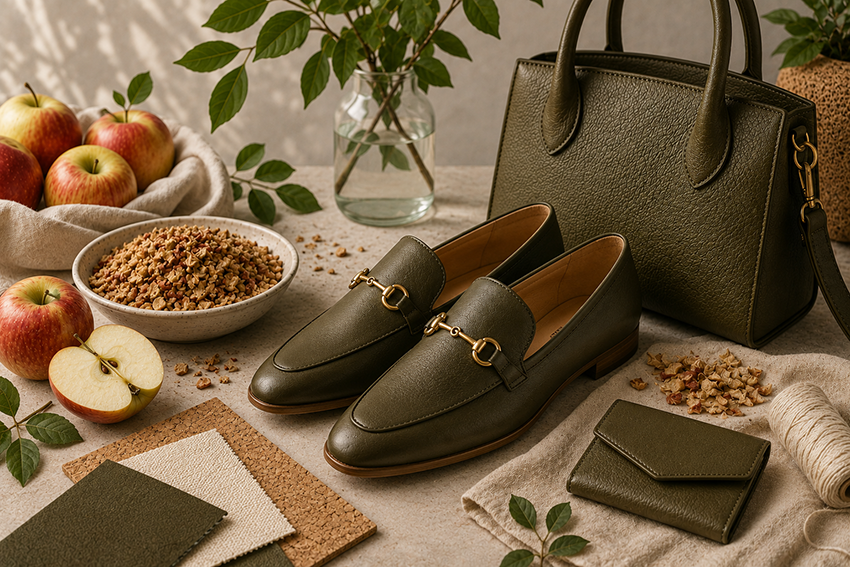
Its key ingredient is apple pomace - the pulp, peel and fibres left behind after apples have been pressed for juice or purée.
These fibres are processed and combined with textiles and protective binders to create a material that closely resembles leather in appearance while remaining completely animal-free.
The goal is not to imitate traditional leather perfectly.
Instead, apple leather offers an alternative built around different priorities: resource efficiency, responsible material innovation and the recovery of agricultural by-products that would otherwise have limited value.
Today, apple leather is commonly used in vegan footwear, handbags, wallets, belts, watch straps and other everyday accessories where durability and flexibility are essential.
A Material Born Between Two Industries
Apple leather connects food production with fashion by turning apple-processing residues into a useful material input.
Instead of treating apple pomace as the end of one production process, manufacturers recover part of it as a raw material for another. This reflects a core circular-economy principle: extending the value of resources that already exist before extracting new ones.
The material will not transform fashion on its own, but it demonstrates how collaboration between industries can create more resource-efficient products.
Why Not Simply Use Traditional Leather?
Traditional leather is valued for its strength, flexibility and long service life. Apple leather addresses a different set of priorities.
For some consumers, avoiding animal-derived materials is essential. Others want to support bio-based innovation or reduce dependence on virgin resources. Apple leather expands the range of available choices rather than replacing every use of traditional leather.
Its value therefore depends on the product, the material composition and the priorities of the person buying it.
Why the Name Can Be Misleading
The name apple leather is memorable, but it can create the impression that the material is made entirely from apples.
In reality, apple leather is best understood as a bio-based composite material. Apple-derived fibres contribute renewable content, while textile backings, binders or coatings provide the flexibility, durability and water resistance required for everyday products.
Different producers use different recipes, so the renewable share can vary significantly from one apple leather to another. The material name alone is therefore less informative than a clear breakdown of the complete composition.
Looking Beyond Simple Labels
Sustainable materials are rarely defined by a single characteristic. A material can contain renewable content and still require synthetic components; another may be highly durable but difficult to recycle.
Apple leather sits between these trade-offs. It uses agricultural by-products and reduces reliance on animal leather, while most current formulations still depend on synthetic binders or coatings for performance.
The most useful question is therefore not whether apple leather is simply “natural” or “sustainable”, but whether the complete material delivers a credible improvement for its intended use.
Did You Know?
The fibres used in apple leather come from apple pomace - the pulp and peel left after juice production. Recovering part of this by-product gives existing agricultural resources an additional use.
How Do You Turn Apples Into Leather?
Apple leather is not made from fresh fruit. It begins with apple pomace, the fibrous material left after apples have been pressed for juice or purée.
The pomace is dried and processed before being combined with other materials that provide the strength, flexibility and surface performance needed for footwear, bags and accessories.
The following steps show how a food-industry by-product becomes a practical fashion material.
From Apple Waste to Fashion Material
The journey from apple pomace to a finished handbag, wallet or pair of sneakers is far more sophisticated than the name "apple leather" might suggest.
Rather than relying on a single ingredient, manufacturers combine natural fibres with modern material engineering to create a product that is both durable and practical.
The process begins where the food industry ends.
From Orchard to Workshop
Every year, millions of tonnes of apples are processed into juice, cider and purée. Once the liquid has been extracted, a fibrous residue remains.
This by-product, known as apple pomace, consists mainly of pulp, peel and cellulose-rich plant fibres.
Instead of treating it as waste, manufacturers recover part of this material and prepare it for a completely different purpose.
Fresh pomace contains a high percentage of moisture, so it must first be dried before it can be processed further.
Once dried, it is milled into a fine powder or fibre that becomes one of the key ingredients in apple leather.
At this stage, the material no longer resembles fruit.
It has become a stable raw material ready to be combined with other components.
Why Apple Leather Isn't Made from Apples Alone
One of the biggest misconceptions surrounding apple leather is that it should be made entirely from apples.
In practice, that simply isn't possible - at least not with today's technology.
Think about what a pair of shoes experiences during its lifetime.
They flex thousands of times.
They carry weight every day.
They are exposed to rain, sunlight, heat and changing temperatures.
Natural apple fibres alone cannot withstand these demands.
To create a material suitable for everyday products, manufacturers combine the apple-derived content with additional materials that improve flexibility, strength and abrasion resistance.
This is why apple leather is best described as a bio-based composite material rather than a purely natural one.
What Is Apple Leather Made From?
There is no universal recipe.
Different manufacturers use different formulations depending on the performance they want to achieve.
Most commercially available apple leather contains a combination of:
| Component | Purpose |
|---|---|
| Apple fibres | Renewable bio-based content |
| Textile backing | Structural stability |
| Polyurethane (PU) | Flexibility and durability |
| Water-based coatings | Surface protection |
| Cotton or recycled polyester | Strength and support |
The exact proportions vary between manufacturers, which means two products labelled "apple leather" may differ in both composition and performance.
This is one reason why transparency from brands is so important.
Does Apple Leather Contain Plastic?
The honest answer is yes.
Most apple leather currently available contains polyurethane (PU) or similar synthetic binders.
Some consumers see this as a disadvantage.
Others overlook it entirely.
The reality lies somewhere between the two.
Polyurethane helps give apple leather the flexibility and durability required for products such as footwear, handbags and wallets.
Without it, the material would currently struggle to meet the performance standards consumers expect.
This doesn't mean the technology has reached its final stage.
Quite the opposite.
Many manufacturers are actively working to increase renewable content while reducing reliance on fossil-based materials.
Apple leather should therefore be seen as a technology that continues to evolve rather than a finished destination.
NWG Perspective
A sustainable material should never be judged by a single ingredient.
The better question is whether the material delivers a meaningful improvement when its full lifecycle, durability and resource use are taken into account.
Is Apple Leather Really Sustainable?
Apple leather is neither a perfect material nor simply a marketing idea. Its sustainability depends on the complete material system: the use of apple-industry by-products, the amount and type of synthetic components, manufacturing, durability and end-of-life options.
Its strongest advantages are the recovery of agricultural by-products and reduced reliance on animal leather. Its main limitations are the synthetic binders or coatings used in most current formulations and the resulting challenges for biodegradability and recycling.
This makes apple leather a useful example of why sustainable materials should be assessed as systems rather than by one headline ingredient.
Where Apple Leather Performs Well
Giving Agricultural By-Products a Second Life
Perhaps apple leather's greatest strength is not the apple itself.
It is the fact that it begins with a material that already exists.
By recovering fibres from the food industry instead of relying entirely on virgin resources, manufacturers extend the value of agricultural by-products and reduce waste within existing production systems.
This is a practical example of circular thinking in action.
Reducing Reliance on Animal Leather
Apple leather provides designers and consumers with another alternative to animal-derived materials.
For people choosing vegan fashion, this offers an opportunity to purchase products that align with their values while maintaining the look and feel of leather.
It is not about replacing every application of traditional leather overnight.
It is about expanding the range of available options.
Encouraging Better Material Innovation
One of the most significant contributions of apple leather is the signal it sends to the wider industry.
Every successful bio-based material encourages further research into renewable alternatives.
Whether future innovations come from apples, mushrooms, seaweed or entirely new sources, each step forward helps reduce dependence on finite resources.
Progress rarely happens through one revolutionary breakthrough.
It happens through continuous improvement. 👉 Read about the leading sustainable vegan fashion materials
Where Apple Leather Still Has Limitations
Transparency also means recognising where the material still has room to improve.
Synthetic Components
Most commercially available apple leather still relies on polyurethane.
This remains one of its biggest environmental challenges and one of the industry's main areas of research.
End of Life
Because it combines plant fibres with synthetic materials, apple leather is generally not biodegradable.
Its composite structure also makes recycling more challenging than products made from a single material.
As recycling technologies develop, this may change.
For now, durability remains one of the material's most important sustainability advantages.
Manufacturing Differences
Not all apple leather is the same.
Manufacturing methods, renewable content and surface finishes vary between producers.
Consumers should therefore look beyond the material name and consider how transparent a brand is about the products it sells.
A Better Way to Compare Materials
There is no single perfect material for every fashion application. Organic cotton, recycled polyester, traditional leather and bio-based composites each involve different environmental and performance trade-offs.
For apple leather, a more useful assessment asks:
- Does it make meaningful use of existing agricultural by-products?
- How transparent is the manufacturer about the complete material composition?
- Is the product durable enough for its intended use?
- Does it reduce reliance on animal-derived or virgin resources?
- Can it remain in use long enough to justify the resources invested in making it?
A product that contains some synthetic content may still reduce reliance on animal-derived or virgin resources, while a highly natural material may perform poorly if it fails too quickly. This framework is more informative than relying on a single headline claim.
NWG Material Assessment
To help readers compare materials consistently, every guide in the NEW WORLD GUARDIANS Material Index follows the same transparent assessment framework.
| Category | Assessment |
|---|---|
| Animal-Free | Excellent |
| Use of Agricultural By-Products | Excellent |
| Renewable Content | Very Good |
| Durability | Very Good |
| Resource Efficiency | Very Good |
| Plastic-Free | Needs Improvement |
| End-of-Life Circularity | Needs Improvement |
| Overall Recommendation | Recommended |
Apple leather represents one of the most promising bio-based materials currently available. While it is not yet a fully circular solution, it demonstrates how thoughtful innovation can reduce reliance on animal-derived materials while making better use of existing resources.
Apple Leather in Everyday Life
Apple leather is now used in premium footwear, handbags, wallets and accessories rather than being limited to experimental collections.
Its suitability depends on the application, construction and finish. Understanding where it performs well is more useful than treating the material as universally “good” or “bad”.
Apple Leather vs Traditional Leather
Apple leather is often presented as a direct replacement for traditional leather.
In reality, the relationship is more nuanced.
Both materials have different strengths because they were developed to solve different challenges.
Traditional leather is valued for its durability, distinctive ageing process and centuries of craftsmanship.
Apple leather was developed to reduce reliance on animal hides while making better use of agricultural by-products.
Rather than competing with one another, they offer consumers different choices based on different priorities.
| Feature | Apple Leather | Traditional Leather |
|---|---|---|
| Animal-derived | No | Yes |
| Vegan | Yes | No |
| Uses agricultural by-products | Yes | No |
| Contains synthetic components | Usually | Sometimes (depending on finishing) |
| Develops a natural patina | Limited | Yes |
| Easy to maintain | Yes | Moderate |
| Biodegradable | Generally no | Depends on tanning and finishing |
Neither material is objectively better.
The right choice depends on what matters most to the individual consumer.
How Does Apple Leather Compare with Other Vegan Materials?
Apple leather is only one member of a rapidly growing family of bio-based materials.
Each approaches sustainability from a slightly different perspective.
| Material | Primary Source | Typical Applications |
|---|---|---|
| Apple Leather | Apple pomace | Shoes, bags, wallets |
| Piñatex® | Pineapple leaves | Bags, accessories |
| Mushroom Leather | Mycelium | Premium fashion |
| Cork | Cork oak bark | Wallets, bags, accessories |
| Corn-based Materials | Plant-derived polymers | Footwear and accessories |
Rather than searching for a single "best" material, it is more useful to understand the strengths and limitations of each.
This is one of the reasons the NEW WORLD GUARDIANS Material Index compares materials using the same evaluation framework across every guide.
How Durable Is Apple Leather?
Durability is one of the most important questions for any bio-based material because a product that remains in use for years generally makes better use of the resources invested in it.
High-quality apple leather is designed for regular use in footwear and accessories. Its performance depends primarily on:
- the quality and composition of the material,
- the craftsmanship of the finished product,
- and the way the product is used and cared for.
There is no single lifespan that applies to every apple leather product. Construction quality, material formulation, frequency of use and exposure to moisture or abrasion all affect performance.
When these factors come together, apple leather can provide the flexibility, abrasion resistance and everyday performance expected from premium shoes, bags and accessories.
Caring for Apple Leather
One of apple leather's practical advantages is that it is relatively easy to maintain.
Unlike traditional leather, it generally does not require specialised conditioners or waxes.
A few simple habits can significantly extend the life of your products.
Cleaning
Wipe the surface regularly using a soft cloth.
For more stubborn marks, use lukewarm water and a small amount of mild soap.
Avoid abrasive cleaners, solvents or alcohol-based products.
Drying
Allow products to dry naturally at room temperature.
Avoid placing shoes or bags directly on radiators or exposing them to excessive heat.
Storage
Store products in a cool, dry place away from prolonged direct sunlight.
Using shoe trees or lightly filling handbags with recycled paper can help maintain their shape during storage.
Daily Care
Simple routines make the biggest difference.
Clean products regularly, avoid unnecessary exposure to moisture and repair items whenever possible instead of replacing them.
A product that lasts for many years is almost always a more sustainable choice than one that needs frequent replacement.
NWG Perspective
At NEW WORLD GUARDIANS, we believe one of the most overlooked sustainability strategies is also the simplest:
Buy less. Choose well. Care for what you own.
Even the most innovative material can only deliver its full environmental benefit if the product is designed to last—and is used for years rather than seasons.
Is Apple Leather Right for You?
Apple leather is an excellent choice if you:
- prefer vegan fashion,
- want to support innovative bio-based materials,
- appreciate products made from agricultural by-products,
- value a premium leather-like appearance,
- and are looking for durable everyday accessories.
You may wish to consider other materials if your highest priority is a completely plastic-free or fully biodegradable product, as most commercially available apple leather does not yet meet those expectations.
For many consumers, however, apple leather offers a thoughtful balance between innovation, performance and responsible resource use.
Final Thoughts
Apple leather reflects a broader shift towards bio-based materials that make better use of existing resources. By incorporating apple pomace from the food industry, it gives agricultural by-products an additional purpose while offering a vegan alternative to animal leather.
Its current limitations matter: most commercial versions still contain synthetic components, and their composite construction can make recycling and biodegradability difficult. That is why transparency, durability and complete material composition remain essential when evaluating a product.
Apple leather is not a perfect solution, but it is a meaningful example of how material innovation can move fashion towards more responsible resource use. The greatest value comes when that innovation is combined with high-quality products designed to stay in use for years.
About NEW WORLD GUARDIANS
At NEW WORLD GUARDIANS, we believe sustainable fashion begins with informed choices.
Our Material Index is designed to cut through marketing claims by evaluating materials using the same transparent framework - examining responsible sourcing, durability, resource efficiency and long-term environmental impact.
Our goal is not to tell you what to buy.
Our goal is to give you the knowledge you need to choose with confidence. 👉 Discover our carefully curated selection of shoes, bags and accessories made from apple leather.
References and Further Reading
This article is based on publicly available technical information, industry publications and scientific research relating to bio-based materials, sustainable fashion and circular design.
Recommended reference sources include:
- AppleSkin™ technical documentation
- Frumat technical information
- Textile Exchange
- European Commission Circular Economy Action Plan
- Scientific literature on bio-based composite materials and Life Cycle Assessment (LCA)
- OEKO-TEX® resources
- USDA Certified Biobased Product Program (where applicable)
Last updated: 6 August 2026