A fur collar can be sold as a finishing touch. A vintage coat can be presented as a sustainable treasure. A fluffy accessory may not even look like something that once belonged to an animal. The distance between the product and the life behind it is precisely why the questions matter.
At NEW WORLD GUARDIANS, we oppose wearing animal fur. We also choose not to celebrate its appearance through imitation fur or vintage styling. For us, fur represents suffering that fashion has too often taught people to overlook. That is our ethical position. Below, we separate that position from scientific findings and practical advice, so you can check the evidence and make informed choices.
If you have worn fur, inherited it or bought something you believed was animal-free, this is an invitation to look closer. Learning something uncomfortable is a reason to change direction, not a reason to feel that you can never get it right. When we speak of ignorance, we mean the information people have not been shown, and the responsibility to question it once they know.
Why is fur a problem?
Real fur uses an animal’s skin and hair. Producing a pelt involves the animal’s death, and contemporary scientific assessments identify serious welfare problems in fur farming. Rabbit fur can be connected to meat production, but that description is not a guarantee about a particular product. Genuine animal-free faux fur avoids using a pelt; it raises separate questions about materials and the message of the fur look.
What happens to animals in the fur industry?
The central welfare concern extends beyond the moment an animal is killed. It includes the life the animal can lead beforehand.
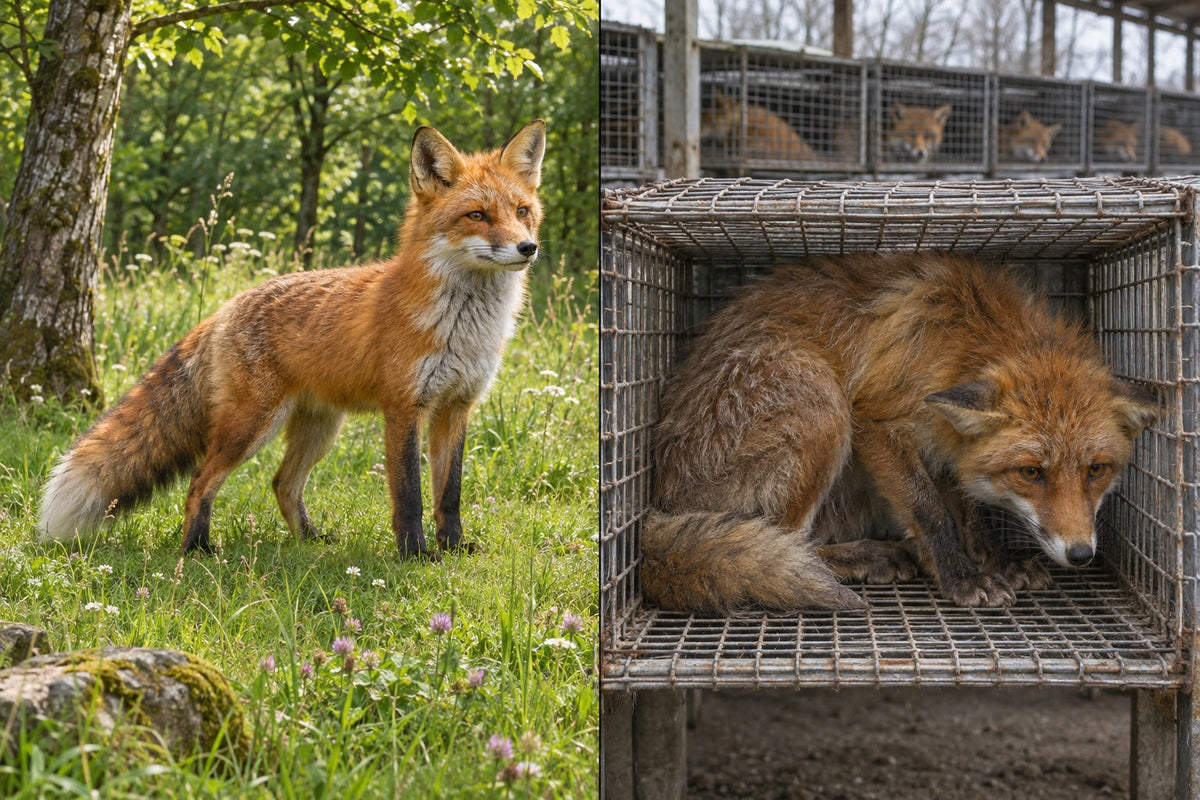
In its 2025 assessment of American mink, red and Arctic foxes, raccoon dogs and chinchillas, the European Food Safety Authority (EFSA) identified restricted movement and frustrated exploration and foraging in small, barren cages. Most of the key welfare consequences could not be significantly reduced within the current cage system. EFSA also described species-specific concerns, including injuries from fighting in mink and leg and paw problems in foxes and raccoon dogs. Its assessment concerns these five species and current farming systems; it does not assess every fur product or every possible enclosure. EFSA welfare assessment [1]
How are animals killed for fur?
Methods vary by species and production system. The UK Animal Welfare Committee’s 2026 opinion describes gassing of mink and electrocution of foxes and raccoon dogs. It raises concerns about distress, the humaneness of killing methods and inadequate independent scrutiny at killing. The committee did not itself observe animals being killed. Its review also identifies suffering associated with current trapping and killing practices for wild-caught fur. AWC fur welfare opinion [2]
This is the reality behind the finished trim: a pelt is obtained from a dead animal. A decorative detail does not become ethically insignificant because it is small.
Does certified or “responsibly sourced” fur solve the problem?
A sourcing label deserves questions about what is assessed, by whom and at which stage. The Animal Welfare Committee concluded that current standards and safeguards did not adequately meet the welfare needs of any species being farmed for fur. AWC fur welfare opinion [2] A certification claim therefore needs to be read alongside independent welfare evidence. It does not make an animal-derived material vegan.
Our position: even a system that reduced suffering would still use and kill animals for fashion. We do not consider that an acceptable basis for a coat, collar or accessory.
Is rabbit fur a by-product of the meat industry?
Sometimes, yes. But “all rabbit fur is simply leftover waste” is an unreliable claim. The answer depends on the production system and the evidence for the individual supply chain.
The FAO’s historical rabbit-husbandry manual describes pelts from meat production, while also discussing rabbits raised specifically for fur, including Rex. It explains that intensive meat production and the requirements for high-quality pelts do not necessarily align. This older technical reference helps explain the distinction; its figures and descriptions should not be treated as a current global market census. FAO rabbit husbandry reference [3]
Three different questions are often hidden inside the word by-product:
- Where did this pelt come from? A seller needs supply-chain evidence to answer that for a particular item.
- Did selling it have economic value? A material sold for money is a revenue stream, even if it was not the main reason the animal was raised. The size of that contribution varies; the label alone does not quantify it.
- Does that make using it acceptable? This is an ethical judgement. At NEW WORLD GUARDIANS, using an animal’s skin remains inconsistent with our values, including when the animal was also used for meat.
A useful question for a retailer is: “What evidence shows whether these rabbits were raised primarily for meat, for pelts or for both, and what welfare information can you provide?” An unsupported “nothing goes to waste” answer does not resolve those questions.

How can you tell the difference between real fur and faux fur?
Start by parting the hairs and examining the backing in good light. Hair emerging from skin suggests real fur; fibres attached to a knitted or woven fabric suggest imitation fur. This is a useful screening check, not a laboratory identification. ASA fur identification guidance [4]
| Check | What it can tell you | Important limit |
|---|---|---|
| Backing | Skin or leather suggests a pelt. A mesh, knitted or woven backing suggests imitation. | The lining may hide the backing. Fabric alone does not prove every fibre is animal-free. |
| Hair tips | Naturally tapering tips can suggest animal hair; blunt ends can suggest cut synthetic fibres. | Real fur can be sheared. Do not decide from the tips alone. |
| Price and feel | Neither reliably identifies the material. | Cheap does not mean fake; softness does not establish origin. |
| Product information | Check the trim and lining separately from the outer fabric. | A main-fabric composition does not answer every question about a detachable collar. |
| Written verification | Ask for the exact fibre composition and confirmation of animal-free components. | For a disputed identification, seek qualified textile analysis. |
The UK advertising regulator’s guidance supports checking the base and hair tips, warns against relying on price or touch, and identifies laboratory analysis as the most accurate approach. ASA fur identification guidance [4] We recommend these non-destructive steps rather than a home burn test: do not set fire to clothing, trims or loose fibres.
What if something sold as faux fur looks real?
Keep the item intact, photograph the label and listing, and save your receipt. Ask the retailer to investigate the exact product and batch. If the description appears misleading, use the relevant consumer-protection or advertising complaint route in your country.
This concern has a documented basis. In 2019, the UK Advertising Standards Authority reported rulings against products advertised as faux fur that contained animal fur. That is evidence that misdescription has occurred, not proof that every imitation-fur product is suspect. ASA misleading faux-fur cases [5]
What do fur labels and product names actually mean?
Read material descriptions literally, and ask about anything left unspecified. A reassuring name is not a complete composition statement.
- Real fur, mink, fox, rabbit or chinchilla: these identify animal-derived materials, not vegan alternatives.
- Faux fur or fake fur: intended to describe imitation. Check the actual fibres and the rest of the garment before assuming it is vegan.
- Vegan fur: ask what the claim covers and what the fibres, backing and other components contain. It does not establish low environmental impact.
- Vintage or secondhand: describes an item’s history, not its material origin.
- Natural, premium or responsibly sourced: ask for the specific claim and supporting evidence. These words do not establish that a product is animal-free.
For textile products within the scope of EU Regulation 1007/2011, Article 12 requires the phrase “Contains non-textile parts of animal origin” where such parts are present. It is not a fur-specific identification: it may refer to another animal-derived component. Its absence should not be treated as independent proof that a garment is vegan. EU textile labelling rules [6]
Is real fur more sustainable than fake fur?
“Natural” and “synthetic” do not, by themselves, settle a finished garment’s environmental impact. A meaningful comparison needs evidence about production, processing, useful life, maintenance and end of life.
The European Environment Agency explains that synthetic textiles use resources and energy and can release microplastics. It also cautions against treating a single fibre type as the universal sustainable choice: performance and impacts depend on the application and life cycle. These are textile-level findings, not a fur-coat comparison. EEA textile life-cycle briefing [7]
Real fur also involves processing. Its animal origin does not tell you whether the finished garment can be composted, how dyes and treatments affect disposal, or what its full footprint is. Likewise, a recycled or partly plant-based imitation needs a complete composition statement and product-specific evidence before strong environmental claims are justified.
Our recommendation is to step outside the real-fur-versus-plastic-fur choice. Keep useful clothing in service, repair it, consider an animal-free secondhand option and choose a design that does not imitate a pelt. Buying another coat is not automatically the best next step.
If faux fur is animal-free, why does NEW WORLD GUARDIANS reject the look too?
Genuine animal-free faux fur does not require an animal pelt. That is a meaningful distinction from real fur. Our objection to wearing it is a separate ethical position about fashion’s visual language.
A passer-by or someone scrolling past a photograph usually cannot inspect a collar’s backing. What they see is the silhouette, texture and styling of fur. We do not want to help present that image as glamorous, aspirational or essential to looking successful.
We are concerned that imitation fur can keep the fur aesthetic desirable. This is our interpretation and reason for avoiding the look; we are not claiming that each faux-fur purchase has been scientifically shown to increase demand for real fur, or that the harms of the two materials are identical.
Many people choose imitation precisely because they care about animals. We recognise that intention. Our invitation is to take the next step: choose warmth, beauty and individuality without making an animal’s coat the reference point.
Is secondhand or vintage fur ethical?
Buying a genuinely secondhand fur coat differs from ordering a newly produced one. Its age, however, does not make the material vegan. People weigh reuse, waste, family history and public messaging differently.
NEW WORLD GUARDIANS does not endorse wearing vintage fur. Our concern is that its visible appearance can still celebrate animals as luxury materials, while viewers cannot know whether it is old or newly made. We do not claim that every resale purchase directly funds a fur farm. We choose to avoid the image as well as new production.
What can you do with an inherited fur coat?
You can value the person who left you an item without wearing everything they owned. You also do not need to rush into throwing it away.
- Separate the memory from the garment. Keep photographs or another meaningful keepsake; retaining the coat privately is also an option.
- Ask a wildlife rehabilitation organisation before donating. Some accept old fur for animal bedding; others cannot use it. Confirm its current policy, accepted condition and shipping instructions first. ACTAsia describes this as one possible route. ACTAsia inherited-fur guidance [8]
- Ask an animal-protection or educational organisation. It may have a specific use, but do not assume it accepts unsolicited garments.
- If no reuse route is suitable, ask your local waste service. Follow local instructions for a treated, mixed-material garment rather than assuming it belongs in compost or textile recycling.
If a collar is detachable, removing it may let you continue using the rest of a coat. For a fixed trim, ask a competent alterations service whether removal is practical before cutting it yourself.
What can you wear instead of fur?
Choose for the job the clothing needs to do: warmth, weather protection, comfort and personal style. None requires the visual imitation of an animal pelt.
- For a winter coat: consider a quilted or insulated design without a fur collar. Check the fill as well as the outer fabric.
- For a softer everyday layer: consider a smooth sweatshirt or knit made with verified animal-free fibres. Choose its weight for your conditions.
- For hats, hoods and accessories: choose simple fabric trims and designs without animal-like pom-poms.
- For a smaller budget: look for suitable secondhand vegan clothing, or repair and layer pieces you already own.
Before buying, ask: “Is the entire garment animal-free, including insulation, lining, trims and any patches? What are the exact materials, and what evidence supports the warmth and weather-protection claims?” A fur-free coat can still contain down, wool or leather.
For more help evaluating fibres, see our organic cotton guide. For a wider approach to animal-free choices, read vegan living beyond food. Material choice should suit the garment; no fibre makes every purchase sustainable.
Winter jackets by NEW WORLD GUARDIANS: positive alternatives to fur
If you are looking for a new winter jacket, our own designs offer practical examples of outerwear without animal fur or the imitation fur look:
- GUARDIAN Puffer Jacket: a padded unisex design with a 100% recycled nylon shell and lining, plus 100% recycled polyester insulation.
- GUARDIAN Padded Parka: a longer unisex option made with recycled polyester, with a quilted lining and an adjustable hood.
Both are vegan designs that let you choose an animal-free style without celebrating the appearance of fur. Compare the fit, materials and care information on each product page, and choose for your own weather conditions and layers.
How can you challenge fur without shaming people?
Fashion can make an inherited habit feel normal. A label can obscure what a product contains. An attractive campaign can invite us to look at the styling and never ask about the animal. People can miss the reality without being indifferent to it.
Start with a question: “Do you know whether that trim is real fur?” If they want to talk, share a specific source and explain your own choice: “I stopped choosing the fur look because I do not want animal pelts to remain a symbol of luxury.”
- Challenge the claim. Ask a brand what “responsible” means and request evidence.
- Share information people can verify. Link to welfare assessments and material-identification guidance.
- Make another style visible. Celebrate outfits that do not rely on fur or its imitation.
- Support policy change. Follow established animal-protection organisations and official consultations.
Fur legislation needs careful reading: a farming ban and a ban on selling imported products are different measures. The European Commission’s current overview describes continuing work on its response to Fur Free Europe; this article does not present that process as an enacted EU-wide sales ban. European Commission policy overview [9]
We want fur to lose its status as an object of admiration. That change begins when the animal’s life becomes more visible than the marketing. You do not need to know every answer before asking a better question, sharing reliable information or choosing differently.
Sources and editorial approach
Prepared by the NEW WORLD GUARDIANS editorial team. Research checked: 12 November 2026. NEW WORLD GUARDIANS is a vegan marketplace with an explicit animal-rights position. Scientific findings, consumer guidance and our ethical interpretation are identified separately. Images are illustrations rather than investigation evidence. This guide does not claim to test garments or certify supply chains.
- EFSA (2025): welfare of five species kept for fur production. Independent scientific assessment; the page links to the full opinion, DOI 10.2903/j.efsa.2025.9519.
- UK Animal Welfare Committee (2026): opinion on the responsible sourcing of fur. Advisory assessment of farmed and wild-caught fur; includes scope and evidence limitations.
- FAO: production of rabbit skins and Angora wool. Historical technical husbandry reference, not current production statistics.
- ASA/CAP (2019): misleading faux-fur claims and identification guidance (PDF). Backing, hair tips and limits of home identification.
- ASA/CAP (2019): real animal fur advertised as faux fur. Documented advertising cases, not a prevalence estimate.
- EU Regulation 1007/2011, Article 12. Labelling of non-textile parts of animal origin in products within its scope.
- European Environment Agency: plastic in textiles. Resource use, microplastics and life-cycle considerations; not a product-specific fur comparison.
- ACTAsia (October 2026): options for inherited fur. Animal-protection organisation offering practical guidance; confirm acceptance directly with any recipient.
- European Commission: animal-welfare overview, section on fur farming. Official policy context and the Commission’s ongoing response to Fur Free Europe.
About NEW WORLD GUARDIANS
NEW WORLD GUARDIANS brings vegan fashion and conscious living together with a commitment to compassion. We want people to understand what they buy, ask for evidence and discover choices that reflect care for animals. Our position on fur is clear: we want fashion to move beyond treating an animal’s coat as a symbol of status.