Discover how mushroom leather is made, how sustainable it really is, and how it compares to traditional leather and other vegan alternatives.
Executive Summary
Mushroom leather is one of the most exciting innovations in sustainable fashion. Instead of using animal hides, this next-generation material is made from mycelium-the root-like network of fungi-which can be cultivated into strong, flexible sheets with a leather-like appearance and feel.
Unlike conventional leather, mushroom leather does not rely on livestock farming and can be produced in a matter of weeks rather than years. This has made it a promising alternative for designers and brands looking to reduce their environmental impact while creating high-quality vegan products.
However, mushroom leather is not a perfect material. Its sustainability depends on how it is grown, processed and finished. Many commercial products include additional coatings or textile backings to improve durability, meaning not every mushroom leather product has the same environmental profile.
As research and manufacturing continue to evolve, mushroom leather is increasingly being used in vegan shoes, vegan bags and luxury fashion. While production is still relatively limited, many experts consider mycelium-based materials among the most promising developments in the future of sustainable fashion.
This guide explains everything you need to know-from how mushroom leather is made to its advantages, limitations and how it compares with traditional leather and other vegan alternatives.
Quick Answer
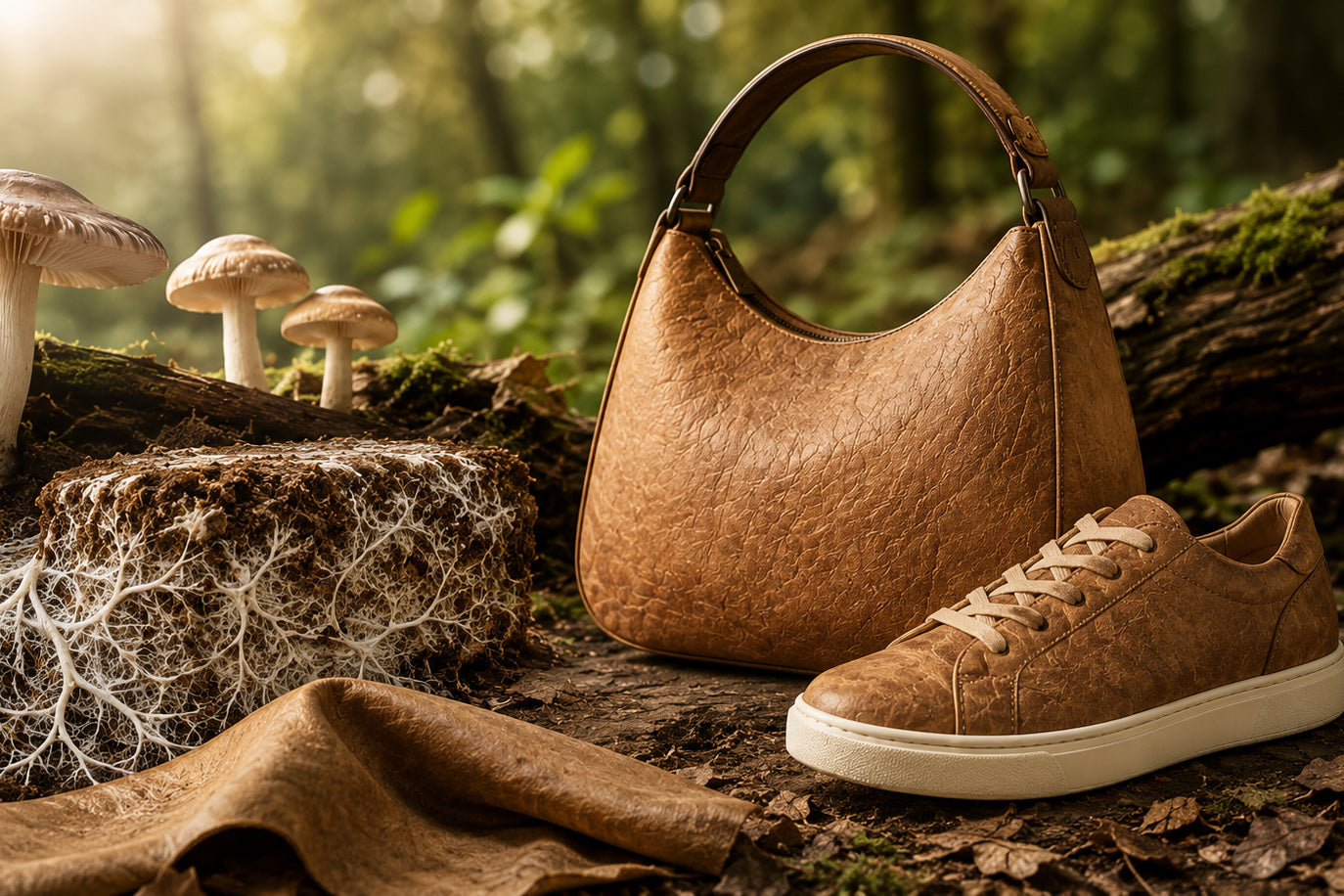
Mushroom leather is a vegan leather alternative made from mycelium, the underground network of fungi. Instead of raising animals, manufacturers cultivate mycelium under controlled conditions, allowing it to grow into dense, leather-like sheets that can be transformed into fashion materials.
Compared with conventional leather, mushroom leather has the potential to use fewer natural resources, avoid animal-derived materials and reduce greenhouse gas emissions associated with livestock farming. While many products still contain protective coatings or reinforcement materials, mushroom leather represents one of the most innovative bio-based materials currently available.
Mushroom Leather at a Glance
| Feature | Assessment |
|---|---|
| Material Type | Bio-based mycelium material |
| Raw Material | Mycelium (fungal root network) |
| Animal-Free | ✔ Yes |
| Renewable Resource | ✔ Yes |
| Biodegradable | Depends on coatings and construction |
| Durability | Good to Very Good |
| Water Resistance | Moderate (often improved with protective finishes) |
| Common Uses | Shoes, handbags, wallets, accessories |
| Commercial Availability | Growing but still limited |
| Overall Sustainability | Excellent potential, technology still evolving |
Why Mushroom Leather Matters
For centuries, leather has been valued for its durability, flexibility and timeless appearance. Yet conventional leather production is also associated with significant environmental and ethical challenges, including livestock farming, land use, greenhouse gas emissions and chemical-intensive tanning processes.
At the same time, many synthetic leather alternatives rely heavily on fossil-based plastics, creating their own environmental concerns.
Mushroom leather offers a different approach.
Instead of harvesting animal hides or producing petroleum-based plastics, manufacturers cultivate mycelium-the natural network of fungal fibres-into a strong and flexible material that can mimic many of the properties of traditional leather.
Although the technology is still developing, mushroom leather demonstrates how biotechnology can create innovative materials using renewable biological resources. As production expands, it has the potential to become an increasingly important part of a more sustainable fashion industry.
NWG Perspective
At NEW WORLD GUARDIANS, we see mushroom leather as one of the most promising examples of how innovation can reshape sustainable fashion. Rather than simply replacing one material with another, mycelium introduces an entirely new way of creating leather-like materials using nature's own biological processes. Like every material, however, its sustainability depends on the complete production process-not just the raw ingredient. Looking beyond marketing claims and understanding how a material is made is essential for making informed choices.
What You'll Learn in This Guide
In this guide, you'll discover:
- What mushroom leather is and how mycelium works.
- How mushroom leather is grown and manufactured.
- The environmental benefits and current limitations of the material.
- How mushroom leather compares with traditional leather and other vegan alternatives.
- Which brands and companies are leading its development.
- How to care for mushroom leather products.
- What to consider before buying mushroom leather fashion.
Key Takeaways
- Mushroom leather is made from mycelium, the root-like structure of fungi-not from mushroom caps.
- It is a vegan, bio-based material developed as an alternative to conventional leather.
- Production takes weeks instead of years and does not require livestock farming.
- Sustainability depends on the complete manufacturing process, including coatings and backing materials.
- Mushroom leather is one of the most promising innovations in sustainable fashion, with growing adoption across the footwear, accessories and luxury sectors.
What Is Mushroom Leather?
Mushroom leather is an innovative bio-based material made primarily from mycelium-the underground network of fine, thread-like fibres that forms the main body of fungi. While mushrooms are the visible fruiting bodies that grow above the ground, mycelium remains hidden beneath the surface, where it naturally breaks down organic matter and transports nutrients.
Scientists have discovered that mycelium can also be cultivated into dense, flexible sheets with properties similar to traditional leather. Instead of relying on animal hides, manufacturers grow this natural fibre network under carefully controlled conditions before processing it into a durable material suitable for fashion and accessories.
Because it is grown rather than harvested from animals, mushroom leather has become one of the most promising alternatives to conventional leather and fossil-based synthetic materials.
However, not all mushroom leather is the same. Different manufacturers use different fungal species, cultivation methods and finishing techniques, meaning the final material can vary in durability, flexibility and environmental performance.
What Is Mycelium?
To understand mushroom leather, it helps to understand mycelium.
Mycelium is the vegetative part of a fungus, consisting of millions of microscopic filaments called hyphae. Together, these fibres form an interconnected network that spreads through soil, wood and other organic matter.
In nature, mycelium plays an essential role in healthy ecosystems. It decomposes dead plant material, recycles nutrients and even forms beneficial relationships with trees and plants by helping them absorb water and minerals.
For material scientists, however, mycelium offers another remarkable property.
When grown under carefully controlled conditions, the tiny fibres naturally weave together into a dense three-dimensional structure that is both lightweight and surprisingly strong. By adjusting factors such as humidity, temperature and nutrients, manufacturers can influence the thickness, flexibility and texture of the material.
Rather than extracting a raw material from nature, mushroom leather is cultivated using nature's own biological processes.
Did You Know?
Although mushroom leather is often associated with mushrooms, the mushrooms themselves are usually not used to make the material. Instead, manufacturers cultivate the mycelium-the much larger underground network that supports fungal growth. In nature, a single mycelial network can spread across several hectares, making some fungi among the largest living organisms on Earth.
How Is Mushroom Leather Made?
Although production methods differ between companies, the manufacturing process generally follows four main steps.
1. Growing the Mycelium
The process begins with selected fungal species grown on nutrient-rich agricultural by-products such as sawdust, hemp fibres or other plant-based residues.
Inside climate-controlled growing facilities, the mycelium rapidly spreads through the substrate, naturally binding the fibres together as it grows.
Unlike raising cattle for leather production, this biological growth usually takes only a few weeks.
2. Forming the Material
As the mycelium develops, it creates a dense network of interwoven fibres.
Depending on the manufacturing technology, the material may be:
- grown into flat sheets,
- moulded into specific shapes, or
- compressed to achieve different textures and thicknesses.
This stage determines many of the characteristics that give mushroom leather its leather-like appearance and flexibility.
3. Stabilising the Material
Once the desired structure has formed, the biological growth is stopped using heat or drying techniques.
This preserves the material and creates a stable sheet that can be further processed for commercial use.
4. Finishing and Reinforcement
The final stage has the greatest influence on how mushroom leather performs.
To improve durability, flexibility and water resistance, manufacturers often combine the mycelium with textile backings or apply protective surface finishes.
These may include:
- recycled textile backings,
- natural fibre fabrics,
- water-based coatings,
- bio-based polymers, or
- synthetic protective layers.
Because these finishing materials differ between manufacturers, two products labelled as "mushroom leather" may have very different environmental profiles.
Why Manufacturing Matters
When people hear the term mushroom leather, it is easy to assume that every product is made in the same way.
In reality, mushroom leather is an umbrella term covering several rapidly evolving technologies.
Factors such as the fungal species used, cultivation methods, reinforcement materials and surface coatings all influence the finished product's durability, appearance and sustainability.
For this reason, understanding how a material is made is just as important as knowing what it is made from.
NWG Perspective
One of the biggest misconceptions about mushroom leather is that it is a single, standardised material. In reality, it is an entire category of innovative biomaterials. At NEW WORLD GUARDIANS, we believe transparency is essential. Looking beyond the headline ingredient and understanding the complete material composition helps consumers make more informed and responsible purchasing decisions.
Key Takeaways
- Mushroom leather is made from mycelium, the underground network of fungi.
- Mycelium naturally forms strong, interconnected fibres that can be cultivated into leather-like sheets.
- Most mushroom leather is grown using agricultural by-products in controlled environments.
- Finished products often include backing materials or protective coatings to improve durability.
- Manufacturing methods vary, making transparency an important factor when assessing sustainability.
Is Mushroom Leather Sustainable?
One of the main reasons mushroom leather has gained attention is its potential to reduce some of the environmental impacts associated with conventional leather. Because it is grown from mycelium rather than produced from animal hides, it avoids livestock farming and can be cultivated using renewable biological resources.
However, sustainability is rarely determined by a single material alone.
The environmental performance of mushroom leather depends on several factors, including how the mycelium is grown, which materials are added during manufacturing and how long the finished product lasts. Understanding these factors helps separate evidence-based information from marketing claims.
Why Mushroom Leather Can Be More Sustainable
Renewable Raw Material
Mycelium is a naturally renewable resource that grows quickly under controlled conditions. Unlike animal leather, it does not require raising livestock over several years and can be cultivated using agricultural by-products such as sawdust or hemp waste.
Its rapid growth also means manufacturers can produce new material within weeks rather than years.
Reduced Dependence on Livestock
Conventional leather is closely linked to cattle farming, which requires significant land, water and feed while contributing to greenhouse gas emissions.
Because mushroom leather is cultivated from fungi instead of animal hides, it avoids these impacts entirely.
For consumers looking to reduce their reliance on animal-derived materials, this is one of mushroom leather's greatest advantages.
Efficient Use of Resources
Growing mycelium generally requires less land than livestock farming and can make use of agricultural by-products that might otherwise be discarded.
This approach supports the principles of a circular economy by giving existing biological resources a second purpose instead of relying solely on newly extracted raw materials.
Current Challenges
While mushroom leather shows enormous potential, the technology is still developing.
Many commercially available products include textile backings or protective coatings to improve durability and water resistance. These additional materials can affect recyclability, biodegradability and the overall environmental footprint.
Production also remains relatively small compared with conventional leather, meaning availability is currently limited and costs are often higher.
Is Mushroom Leather Biodegradable?
This is one of the most common questions - and the answer is it depends.
Mycelium itself is a natural material that can biodegrade under suitable conditions. However, finished mushroom leather products often contain additional components such as coatings, adhesives or textile reinforcements.
These layers improve durability but may reduce or prevent biodegradability.
For this reason, it is more accurate to evaluate the complete product rather than assuming every mushroom leather item is fully biodegradable.
Sustainability Comparison
| Aspect | Mushroom Leather | Animal Leather |
|---|---|---|
| Animal-Free | ✔ Yes | ✖ No |
| Renewable Resource | ✔ Yes | ✔ Yes |
| Livestock Required | ✖ No | ✔ Yes |
| Growth Time | Weeks | Several years |
| Resource Efficiency | High | Lower |
| Biodegradable | Depends on construction | Depends on tanning process |
NWG Perspective
At NEW WORLD GUARDIANS, we believe mushroom leather represents one of the most promising innovations in sustainable fashion - not because it is perfect, but because it rethinks how leather-like materials can be created. As with every material, the real environmental impact depends on transparency, responsible manufacturing and product longevity rather than the raw ingredient alone.
Key Takeaways
- Mushroom leather is grown from renewable mycelium instead of animal hides.
- It avoids livestock farming and can make use of agricultural by-products.
- Sustainability depends on the complete manufacturing process, including coatings and reinforcement materials.
- Pure mycelium is biodegradable, but finished products may not be.
- Choosing durable, well-made products remains one of the most important factors for reducing environmental impact.
Advantages and Disadvantages of Mushroom Leather
Like every fashion material, mushroom leather has both strengths and limitations. While it offers an innovative alternative to conventional leather, its performance depends on how it is manufactured and the intended use of the finished product.
Understanding these advantages and trade-offs helps consumers make informed purchasing decisions based on facts rather than marketing claims.
Advantages
Animal-Free
Mushroom leather is made without animal hides, making it a suitable choice for consumers looking for vegan and cruelty-free fashion.
Instead of relying on livestock farming, manufacturers cultivate mycelium under controlled conditions, creating a material that offers many of the characteristics associated with traditional leather.
Made from Renewable Resources
Unlike synthetic leather, which is typically derived from fossil fuels, mushroom leather is based on mycelium-a naturally renewable biological material.
Many manufacturers also use agricultural by-products as growing substrates, helping to make better use of existing resources.
Lower Environmental Impact Potential
Although environmental performance varies between manufacturers, mushroom leather has the potential to reduce land use, water consumption and greenhouse gas emissions associated with conventional leather production.
Its relatively fast growth cycle also allows materials to be produced within weeks rather than years.
Premium Appearance
Modern mushroom leather can closely resemble traditional leather in both appearance and texture.
Depending on the production method, manufacturers can create smooth finishes, natural grain patterns and flexible materials suitable for handbags, footwear and accessories.
Limitations
Limited Availability
Mushroom leather is still an emerging material.
Compared with conventional leather or PU leather, commercial production remains relatively small, meaning products are less widely available and often released in limited collections.
Higher Cost
Because production technologies are still developing, mushroom leather products are generally positioned in the premium market.
As manufacturing capacity grows, prices are expected to become more competitive.
Material Composition Varies
Not every mushroom leather product is made entirely from mycelium.
Many include textile backings or protective coatings to improve durability and water resistance.
For this reason, consumers should always look beyond the product name and consider the complete material composition.
Advantages and Disadvantages at a Glance
| Advantages | Limitations |
|---|---|
| ✔ Animal-free | Limited availability |
| ✔ Renewable raw material | Higher production costs |
| ✔ Lower environmental impact potential | Material composition varies |
| ✔ Premium look and feel | Technology still developing |
| ✔ Rapid cultivation | Long-term performance data is still growing |
NWG Perspective
Every material involves trade-offs, and mushroom leather is no exception. While it offers exciting possibilities for reducing reliance on animal leather, no material should be judged solely by its headline ingredient. Durability, responsible manufacturing and transparent sourcing remain just as important as the material itself. Choosing a well-made product designed to last will almost always have a greater positive impact than simply following the latest innovation.
Key Takeaways
- Mushroom leather is a renewable, animal-free material with significant sustainability potential.
- It can closely replicate the appearance and feel of traditional leather.
- Availability is currently limited, and products often come at a premium price.
- Material composition differs between manufacturers, making transparency essential.
- Long-lasting, high-quality products remain the most sustainable choice regardless of the material used.
Mushroom Leather vs Animal Leather
For centuries, animal leather has been valued for its durability, craftsmanship and timeless appeal. Today, innovative biomaterials such as mushroom leather offer consumers an alternative that avoids animal-derived materials while aiming to reduce environmental impacts.
Rather than asking which material is better, it's more useful to understand where each one performs best. The right choice depends on your priorities-whether they are sustainability, durability, aesthetics or animal welfare.
Quick Comparison
| Feature | Mushroom Leather | Animal Leather |
|---|---|---|
| Source | Mycelium (fungi) | Animal hides |
| Vegan | ✔ Yes | ✖ No |
| Renewable | ✔ Yes | ✔ Yes |
| Livestock Required | ✖ No | ✔ Yes |
| Typical Production Time | Weeks | Several years |
| Environmental Impact | Lower potential* | Higher due to livestock and tanning |
| Durability | Good to Very Good | Excellent |
| Natural Patina | Limited | Develops over time |
| Availability | Limited | Widely available |
*Depends on manufacturing methods and material composition.
Sustainability
One of the biggest differences between the two materials is how they are produced.
Animal leather depends on livestock farming, which requires significant land, water and feed while contributing to greenhouse gas emissions. The tanning process can also involve chemicals that require careful management to minimise environmental impacts.
Mushroom leather, by contrast, is cultivated from mycelium in controlled environments. It can be grown within weeks using renewable biological resources and often makes use of agricultural by-products.
While mushroom leather is not impact-free, it avoids many of the environmental challenges associated with raising animals for leather production.
Durability
Animal leather has earned its reputation through centuries of use. When properly cared for, high-quality leather products can last for decades and often develop a unique patina that many consumers appreciate.
Mushroom leather has improved rapidly in recent years and is now suitable for many fashion applications, including handbags, footwear and accessories. However, because the technology is still relatively new, long-term performance depends on the manufacturer, material construction and intended use.
For everyday fashion products, premium mushroom leather can offer excellent durability, but it has not yet built the same decades-long track record as traditional leather.
Appearance and Feel
Modern mushroom leather is designed to replicate many of the qualities people associate with premium leather.
Depending on the production process, it can feature:
- a soft texture,
- flexible construction,
- natural-looking grain patterns,
- and a high-quality finish.
Unlike animal leather, whose appearance is shaped by nature, mushroom leather can be engineered to achieve more consistent textures and finishes.
Both materials offer a premium look, but they achieve it in different ways.
Care and Maintenance
Both materials benefit from proper care, although maintenance requirements differ slightly.
Animal leather usually requires regular conditioning to maintain its flexibility and prevent cracking. It should also be protected from excessive moisture and stored in a dry environment.
Mushroom leather is generally lower maintenance. Most products can be cleaned with a soft, damp cloth and should be kept away from prolonged exposure to water or excessive heat. Always follow the care instructions provided by the manufacturer, as different finishes may require different treatments.
NWG Perspective
At NEW WORLD GUARDIANS, we believe mushroom leather should not be viewed as a direct replacement for every leather product. Instead, it represents an exciting new category of biomaterials that expands the range of sustainable fashion choices. As innovation continues, consumers will increasingly be able to choose materials that align not only with their style but also with their environmental and ethical values.
Key Takeaways
- Mushroom leather and animal leather are fundamentally different materials with distinct strengths.
- Mushroom leather is animal-free, rapidly renewable and offers significant sustainability potential.
- Animal leather remains the benchmark for long-term durability and develops a natural patina over time.
- Product quality and manufacturing methods are just as important as the material itself.
- The best choice depends on your personal priorities rather than a single "better" material.
Mushroom Leather vs Other Vegan Leather Alternatives
Mushroom leather is one of several innovative materials helping reduce reliance on conventional leather and fossil-based synthetics. While each material has its own strengths, they all aim to create more responsible alternatives for the fashion industry.
The best choice depends on your priorities, whether that's using agricultural waste, supporting new biotechnology or reducing dependence on petroleum-based materials.
Mushroom Leather vs Apple Leather
Apple leather is made using apple pomace, a by-product of the juice industry, while mushroom leather is cultivated from mycelium.
Both are animal-free alternatives, but mushroom leather more closely replicates the natural look and feel of traditional leather, whereas apple leather gives new value to agricultural waste.
Best for: Consumers looking for premium leather-like aesthetics or circular use of food-industry by-products.
Mushroom Leather vs Piñatex®
Piñatex® is produced from pineapple leaf fibres, an agricultural by-product, resulting in a lightweight material with a distinctive textured finish.
Mushroom leather offers a softer, more leather-like appearance, while Piñatex® provides a unique aesthetic that has become popular in fashion accessories.
Mushroom Leather vs Cactus Leather
Cactus leather is made using mature cactus leaves combined with textile backings and coatings.
Like mushroom leather, it reduces dependence on animal leather, but the materials differ significantly in how they are produced. Mushroom leather is cultivated from mycelium, while cactus leather relies on plant fibres.
Mushroom Leather vs PU Leather
PU leather remains one of the most common vegan leather materials but is largely derived from fossil-based plastics.
Mushroom leather aims to replace part of these synthetic materials with renewable biological resources while offering comparable functionality for many fashion applications.
Comparison Overview
| Material | Main Raw Material | Animal-Free | Renewable | Availability |
|---|---|---|---|---|
| Mushroom Leather | Mycelium | ✓ | ✓ | Limited |
| Apple Leather | Apple pomace | ✓ | Partly | Growing |
| Pineapple leather | Pineapple leaf fibres | ✓ | ✓ | Moderate |
| Cactus Leather | Cactus leaves | ✓ | Partly | Growing |
| PU Leather | Polyurethane | ✓ | ✗ | Excellent |
NWG Perspective
There is no single "perfect" vegan leather. Every material offers different environmental advantages and trade-offs. Understanding how these materials are made allows consumers to make more informed purchasing decisions.
Key Takeaways
- Mushroom leather is one of the newest bio-based leather alternatives.
- Apple leather and Piñatex® both utilise agricultural by-products.
- Cactus leather and mushroom leather rely on different production methods.
- PU leather remains the most common vegan leather but depends largely on fossil-based resources.
How to Care for Mushroom Leather
Like any high-quality fashion material, mushroom leather lasts longest when it is properly cared for. Although it shares many characteristics with traditional leather, it does not require the same level of maintenance.
Most mushroom leather products are designed for everyday use and can be kept in excellent condition with a few simple care habits.
Cleaning Mushroom Leather
Regular cleaning helps preserve the appearance of mushroom leather and prevents dirt from building up over time.
For most products:
- Wipe the surface with a soft, slightly damp cloth.
- Remove dust and dirt gently without scrubbing.
- Allow the material to air dry naturally.
- Avoid using harsh chemicals or abrasive cleaning products.
If a deeper clean is required, always follow the care instructions provided by the manufacturer, as different finishes may require different treatment.
Is Mushroom Leather Waterproof?
No. Mushroom leather is not naturally waterproof.
Many products are treated with protective coatings that improve water resistance, making them suitable for normal daily use. However, prolonged exposure to heavy rain or standing water can still damage the material over time.
If your mushroom leather product becomes wet:
- Gently blot away excess moisture with a soft cloth.
- Allow it to dry naturally at room temperature.
- Avoid direct sunlight, radiators or hairdryers, as excessive heat may affect the material.
Storage Tips
Proper storage helps maintain both the appearance and durability of mushroom leather products.
For best results:
- Store in a cool, dry place.
- Keep away from prolonged direct sunlight.
- Avoid excessive humidity.
- Use a dust bag for handbags or accessories when not in use.
- Do not place heavy objects on top of products that could lose their shape.
Good storage habits help preserve the material and reduce unnecessary wear.
Does Mushroom Leather Crack or Peel?
High-quality mushroom leather is designed to withstand everyday use, but like any material, its lifespan depends on construction, care and frequency of use.
Poor maintenance, excessive moisture or repeated exposure to heat can shorten the life of the material.
Products made with high-quality finishes and careful craftsmanship are generally more resistant to cracking and surface wear than lower-quality alternatives.
Choosing well-made products from transparent brands is therefore just as important as selecting the material itself.
Can Mushroom Leather Be Repaired?
Minor scuffs or surface marks can often be cleaned or improved following the manufacturer's care recommendations.
More significant damage may require professional repair, depending on how the product is constructed.
As mushroom leather becomes more widely available, repair services and specialised care products are also expected to become more common.
Whenever possible, repairing a product instead of replacing it helps extend its lifespan and reduces waste.
Care Checklist
✔ Clean regularly with a soft, damp cloth.
✔ Avoid harsh cleaning products and solvents.
✔ Keep away from prolonged moisture.
✔ Let products dry naturally if they become wet.
✔ Store in a cool, dry place away from direct sunlight.
✔ Follow the manufacturer's care instructions for the specific product.
NWG Perspective
One of the most sustainable choices you can make isn't simply choosing a better material—it's making your products last. Whether a bag is made from mushroom leather, apple leather or traditional leather, proper care extends its lifespan, reduces waste and helps lower its overall environmental impact. Buying less and caring for what you own remains one of the most effective ways to support a more sustainable wardrobe.
Key Takeaways
- Mushroom leather is relatively easy to care for and does not usually require specialised maintenance.
- Clean products with a soft, damp cloth and avoid harsh chemicals.
- Most mushroom leather is water-resistant rather than waterproof.
- Proper storage helps maintain appearance and durability.
- Repairing and caring for products can significantly extend their lifespan, making them a more sustainable long-term choice.
What to Look for When Buying Mushroom Leather
As mushroom leather becomes more widely available, not all products offer the same level of quality or sustainability. Looking beyond marketing claims can help you choose products that are built to last.
1. Check the Material Composition
Most mushroom leather products combine mycelium with textile backings or protective coatings to improve durability.
Look for brands that clearly explain:
- material composition
- bio-based content
- backing fabrics
- protective finishes
Transparency is often a good indicator of responsible manufacturing.
2. Focus on Quality
A durable, well-made product is usually a more sustainable choice than a lower-quality item that needs replacing sooner.
Pay attention to:
- stitching
- construction
- overall craftsmanship
- repairability
3. Buy From Transparent Brands
Choose companies that openly communicate how their materials are sourced and manufactured.
The more information a brand provides, the easier it is to make an informed decision.
4. Buy for Long-Term Use
Choose products that suit your lifestyle and are designed to last beyond changing trends.
Using an item for many years is one of the simplest ways to reduce its overall environmental impact.
Explore our vegan sneakers for women and vegan sneakers for men for everyday wear.
Buying Checklist
✔ Transparent material composition
✔ High-quality craftsmanship
✔ Responsible sourcing
✔ Timeless design
✔ Easy to care for
NWG Perspective
Sustainable fashion is about more than innovative materials. Choosing durable, responsibly made products—and using them for as long as possible—often has the greatest positive impact.
Key Takeaways
- Check the material composition.
- Prioritise quality and durability.
- Choose transparent brands.
- Buy products you'll use for years.
Final Thoughts
Mushroom leather represents an exciting shift in how fashion materials can be created. Instead of relying on animal hides or fossil-based plastics, it uses the natural growth of mycelium to produce a material that combines innovation with sustainability.
While the technology is still evolving, mushroom leather already demonstrates how biotechnology can help reduce dependence on conventional leather and support the transition towards more responsible fashion.
Like every material, it comes with strengths and limitations. Its true environmental impact depends not only on the mycelium itself but also on how the final product is manufactured, used and cared for throughout its lifetime.
For consumers, the most sustainable choice is rarely about finding a "perfect" material. It is about choosing well-made products, using them for as long as possible and supporting brands that value quality, transparency and responsible production.
As research continues and production scales up, mushroom leather is likely to become an increasingly important part of the sustainable fashion landscape.
About NEW WORLD GUARDIANS
At NEW WORLD GUARDIANS, we believe that better fashion starts with better information. Our mission is to help consumers make informed choices by providing independent, well-researched guides on sustainable materials, ethical fashion and responsible brands.
Rather than promoting trends or making unsupported environmental claims, we focus on transparency, evidence-based research and practical advice that empowers people to build a more conscious wardrobe.
Explore our growing Material Library, discover carefully curated vegan fashion brands and learn how innovative materials are shaping the future of fashion.
Resources
This guide has been prepared using information from scientific literature, industry publications and publicly available resources from organisations and companies working with innovative biomaterials.
Further Reading
- MycoWorks – Information on Fine Mycelium™ technology
- Ecovative – Mycelium materials and biotechnology
- Biofabricate – Innovation in biomaterials and next-generation textiles
- Textile Exchange – Sustainable materials and preferred fibres
- Ellen MacArthur Foundation – Circular economy in fashion
- Fashion for Good – Reports on next-generation materials
As research into mushroom leather continues to evolve, this guide will be reviewed and updated to reflect significant developments in material science, commercial availability and sustainability research.
Last updated: July 2026